
+91 90324 21995 [email protected] Tirupati, Andhra Pradesh
+91 90324 21995

UVM Course

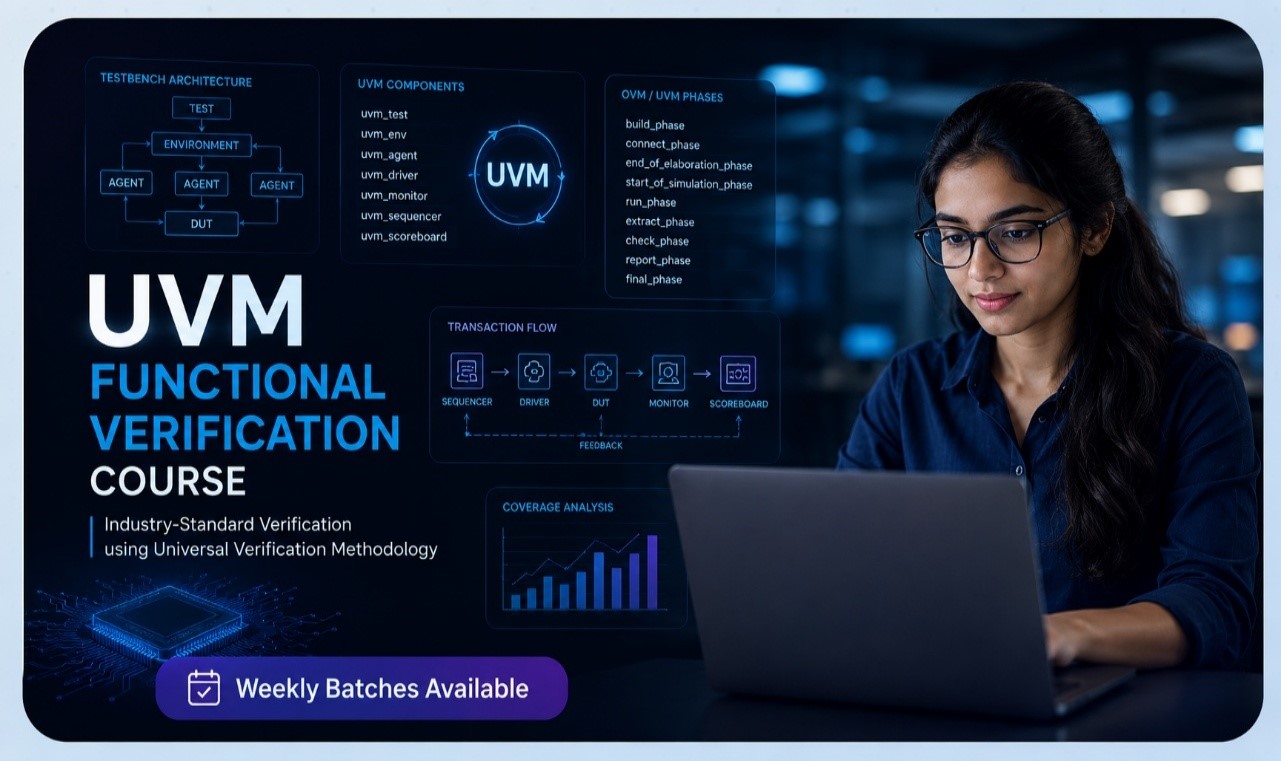
Master Universal Verification Methodology (UVM) by developing reusable verification environments, constrained-random testbenches, functional coverage, scoreboards, and verification components through hands-on projects, live mentoring, and career assistance.
4.8/5 Student Rating
5,000+ Students Trained
200+ Hiring Partners
Weekly Batches Available

UVM Functional Verification Course

Duration: 2 Months
Mode: Online / Offline
Language: English, Telugu, Tamil, Hindi
Industry-Recognized Certification from Takeoff Training Institute
Python for Data Science
Machine Learning
Deep Learning
Data Visualization
AI & Neural Networks
Model Deployment
Real Industry Projects
Placement Support
Pandas & NumPy
Statistics & Probability
Python for Data Science
Machine Learning
Deep Learning
Data Visualization
AI & Neural Networks
Model Deployment
Real Industry Projects
Placement Support
Pandas & NumPy
Statistics & Probability
Course Curriculum

Comprehensive UVM Functional Verification Course Curriculum

The UVM Functional Verification is a career-focused program designed to equip learners with the knowledge and practical skills required to excel in modern VLSI functional verification. The curriculum covers Universal Verification Methodology (UVM), object-oriented programming (OOP) concepts, UVM architecture, factory mechanisms, phasing, objections, configuration and resource databases, sequence items, sequences, sequencers, drivers, monitors, agents, environments, scoreboards, subscribers, transaction-level modeling (TLM), functional coverage, callbacks, events, barriers, command-line processing, register abstraction layer (RAL), and advanced UVM debugging techniques. Through hands-on laboratory exercises, real-world verification projects, protocol-based case studies, and capstone implementations, learners gain practical experience in developing reusable, scalable, and robust verification environments for ASIC and FPGA designs. The program also includes verification of industry-standard protocols such as FIFO, UART, SPI, APB, and AXI, along with verification planning, coverage closure, resume building, interview preparation, and placement assistance, ensuring learners are fully prepared for roles such as UVM Verification Engineer, Design Verification (DV) Engineer, ASIC Verification Engineer, SoC Verification Engineer, FPGA Verification Engineer, and other high-demand semiconductor industry positions.

Detailed Syllabus

Verification Fundamentals & UVM Introduction

Digital Verification Basics
Verification Methodologies (VMM & OVM & UVM)
Why UVM?
UVM Architecture
UVM Class Hierarchy
UVM Library Structure
UVM Compilation & Simulation Flow
First UVM Program

UVM Factory & Object-Oriented Concepts

Factory Registration
Object Creation
Type & Instance Override
Factory Debugging
UVM Object Utilities
Object-Oriented Programming in UVM

UVM Phasing & Simulation Control

UVM Phases
Build & Connect Phases
Run-Time Phases
Cleanup Phases
UVM Objections
Drain Time
Simulation Control
Phase Debugging

UVM Objects & Transaction Modeling

uvm_object
Sequence Item
Randomization
Constraints
Field Automation Macros
Print & Copy & Clone & Compare
Pack & Unpack Methods

UVM Configuration & Resource Management

Configuration Database (config_db)
Resource Database (resource_db)
Virtual Interfaces
Passing Configuration
Multiple Agent Configuration
Configuration Debugging

UVM Testbench Architecture

UVM Test
Environment
Agent
Driver
Monitor
Sequencer
Sequence
Testbench Top
Virtual Interface Connection

Sequences & Sequencers

Basic Sequences
Constrained Random Sequences
Sequence Macros
Virtual Sequences
Virtual Sequencers
Arbitration
Lock & Grab
Request-Response Mechanism

UVM Communication & TLM

TLM Ports
Analysis Ports
Analysis Export
Analysis FIFO
Transaction Communication
Driver-Sequencer Communication
Monitor Broadcasting

Scoreboard, Coverage & Debug

Scoreboard Design
Reference Models
Functional Coverage
Coverage Collection
Subscribers
UVM Reports
Verbosity Control
Debug Techniques

Advanced UVM Features

UVM Callbacks
UVM Events
UVM Barriers
UVM Heartbeat
Pools & Queues
Command-Line Processor
Factory Debugging
Resource Management

Verification IP (VIP) Development

Reusable Verification Components (UVC)
Active & Passive Agents
Reusable Testbench Design
Verification Planning
Verification Methodology Best Practices
Industry Coding Standards

Protocol Verification

FIFO Verification
Memory Verification
UART Verification
SPI Verification
APB Verification
AXI4-Lite Verification
AXI4 Verification

Functional Coverage & Assertions

Functional Coverage
Covergroups
Coverpoints
Cross Coverage
Coverage Analysis
Assertion-Based Verification (SVA)
Functional Verification Metrics

Industry-Oriented UVM Projects

Adder Verification
FIFO Verification
UART Verification
APB Verification
AXI Verification
Memory Controller Verification
Protocol-Based Verification Projects

Capstone Project & Placement Preparation

Complete UVM Verification Environment
End-to-End DUT Verification
Functional Coverage Closure
Debugging Real Industry Testbenches
Mock Interviews
Resume Building
Placement Assistance
Industry Best Practices
Technologies

Key Tools You'll Master

Master industry-leading verification simulators including QuestaSim and ModelSim through hands-on UVM projects, protocol verification, and real-world ASIC/FPGA verification applications.
QuestaSim
ModelSim

Course Schedule

India Standard Time (IST)

Duration
2 Months
Total Hours
60+ Hours
Weekly Hours
12h per week
Classes per Week
6 Sessions
Course Features

What's Included

Everything you need to succeed - from day one to your first job offer.

Industry-Aligned Curriculum

Learn the latest UVM Functional Verification concepts and industry-standard verification methodologies used in ASIC and SoC development.

Hands-on Laboratory Sessions

Gain practical experience through guided lab sessions covering UVM components, testbench development, simulation, and debugging techniques.

Real-Time Verification Projects

Build reusable verification environments for industry-relevant designs such as FIFO, UART, SPI, I²C, APB, and AXI protocols.

Protocol Verification

Master verification of standard communication protocols using scalable and reusable UVM-based verification environments.

Functional Coverage & Debugging

Develop expertise in functional coverage, assertions, debugging strategies, and coverage closure techniques to improve verification quality.

Capstone Project

Design and implement a complete UVM verification environment for real-world digital designs following industry best practices.

Certification

Course Completion Certificate

Earn an industry-recognized certificate upon successfully completing the program.
Course Completion Certificate
Recognized Professional Certificate
Start Your Career

Ready to Launch Your Career?

Talk to our training advisors and get a personalized learning roadmap, course fee details, batch schedule, and career guidance - all for free.

Free 1-on-1 Career Consultation
Personalized Learning Roadmap
Course Fee & EMI Details
Upcoming Batch Schedule
Free Demo Class Booking

Talk to a Career Expert

Fill in your details - our advisor will contact you within 24 hours.